Requests for any use of any building facilities shall be made by submitting the attached Building Use Request Form. The Building Proprietor will review all requests. After review, the applicant will be contacted to complete the process. Once the application is reviewed and approved, the event will be added to the Building Use Calendar.
A deposit of $100.00 must accompany all requests for building use. The applicant must be the host of the event and remain on St. Mark’s Building property for the duration of the event. Upon approval, a Building Usage fee must be paid using the schedule below:
Fellowship Hall and Kitchen
$125.00
0 – 70 guests
Worship/Concert Space
$225.00
0-150 guests
(Max capacity varies per room. Please note in your request how many people you are hosting)
FACILITY USE CONDITIONS AND RULES:
Historic St. Mark’s reserves the right to reject any request for the use of the facilities. Moreover, HSM reserves the right to cancel the usage of facilities for any reason at any time without prior notice. The following rules and conditions apply to the use of the HSM facilities:
CONDITIONS:
1. Requests may be made between three (3) months and 14 days prior to the event date. Should the party requesting the use of the facilities need to cancel, notice must be given as soon as possible. Failure to notify HSM proprietor of a cancellation within 7 days of the scheduled use will result in the forfeiture of all fees and deposits.
2. Anyone using the facilities agrees to indemnify, save, and hold harmless HSM of and from any claims, actions, causes of action, demands, rights, damages, costs, and expenses, including reasonable attorney’s fees, arising out of any incident, accident, or event that any person using the facilities causes any harm to any individual or to any HSM.
3. Organized non-profit groups must provide HSM with proof of insurance and add HSM as an additional insured as it pertains to the group’s insurance policy. Groups must carry a minimum limit of insurance of at least $500,000 per claim and $500,000 per occurrence. This proof of insurance (certificate of insurance) must be submitted to the church office at least fourteen days prior to the requested date of facilities use.
4. Anyone using the facilities must leave them as they were found. Any damage to the facilities (including discharging of fire extinguishing equipment) will be the responsibility of the person(s) requesting the use of the facility. Repair or replacement of the damaged property will be at the sole discretion of HSM. The deposit submitted with the request form will be held pending inspection and inventory and will be returned within 30 days after the event. The user assumes liability for injuries to persons attending the event and for damages or loss of user’s property.
5. Deposits and Fees: A deposit of $100.00 must be submitted along with each Building Use Request Form. The fee(s) must be paid at least 14 days prior to the requested date for use of the facilities.
6. All trash and refuse must be bagged, tied, and kept in the trash container to be removed by the custodian.
7. The building must be vacated by the end time listed on the request form. All events must be conclude by 11:00 p.m.
8. The member hosting the event must be on the premises the entire time requested.
9. All items associated with the event must be removed immediately following the event. HSM assumes no responsibility or liability for items or property brought onto or left on the property by any party.l HSM reserves the right to dispose of any item or property that has not been removed 14 days after the event.
FACILITY RULES:
1. The following are not allowed on HSM property at any time: weapons, tobacco products, controlled substances/drugs. Alcoholic beverages should be used with discretion and not distract from a Christian atmosphere.
2. No animals are permitted within the facility except those assisting a person with a disability or unless HSM has expressly granted permission in the event a special program is scheduled.
3. Anyone using the facilities must do so in a responsible manner, treating the facility with dignity and respect. Those using the facility will not exhibit disruptive behavior or use inappropriate language..
4. Facility users must provide a minimum ration or 1:8 of adult chaperones for any event involving minors and NO LESS THAN two adult chaperones (over the age of 18) present at any time. When children are in attendance, they must be under control of their parents or adult chaperones at all times and are not permitted to roam freely on HSM property.
5. All users are required to remain in the room(s) specified and approved on their Building Use Request Form and are not to enter any other areas of the building except the restrooms. Moreover, they are also required to enter and exit only through the designated entrance(s) and exit(s).
6. Food and beverages may not be consumed beyond the Fellowship Hall and/or kitchen without prior approval by the Building Proprietor.
7. No decorations, posters, photographs, or other items may be mounted or affixed to any walls, ceilings, or woodwork using any technique that would mar the wall surface. Easels are available upon request. Confetti and glitter are not permitted.
8. No HSM property shall be removed from the facility unless advance written approval from the HSM proprietor is granted.
9. The use of the facility must not interfere with other building usage activities.
10.The facility will not be used for any business purposes or fund-raising other than those authorized by the HSM proprietor. To avoid any scheduling, security or maintenance conflicts, all building usage must be placed on the calendar via the HSM Proprietor. No admission or related fees will be charged by the entity requesting facility use unless approved by the building proprietor.
11.Supplies (kitchen paper products, coffee, craft supplies, etc.) belonging to HSM, with the exception of Bunn coffee filters, are not to be used.
12.The use of candles is prohibited. The use of battery operated candles is recommended.
13. If furniture or equipment is to be moved, it must be done with permission of the Proprietor to maintain the quality of the building’s furniture and equipment and to prevent damage and/or injury.
KITCHEN USAGE SPECIFICS:
When the Fellowship Hall is rented for an event, this includes the use of the refrigerator, freezer, coffee maker,(including (lg. filters), the gas stove, microwave, and the sinks. Note: The stove top is to be used for warming only….No frying.
No paper products found in the pantry are to be used for any non-HSM sanctioned events. Please bring your own disposable items. If you use any of our dishes for any reason, please wash, dry and return them to their designated spot.
Willful violation of any rules or conditions could lead to removal from HSM property, forfeiture of deposit and/or loss of eligibility to use the facility
Revised 3/2025
Historic St. Mark’s Event Center
146 College Street Wadsworth, OH 44281
Roger Havens, Contact
330-336-5548
wadsworthareahistoricalsociety@gmail.com
-BUILDING USAGE INFORMATION SHEET-
Requests for any use of any building facilities shall be made by submitting the attached Building Use Request Form. The Building Proprietor will review all requests. After review, the applicant will be contacted to complete the process. Once the application is reviewed and approved, the event will be added to the Building Use Calendar.
A deposit of $100.00 must accompany all requests for building use. The applicant must be the host of the event and remain on St. Mark’s Building property for the duration of the event. Upon approval, a Building Usage fee must be paid using the schedule below:
Fellowship Hall and Kitchen
$125.00
0 – 70 guests
Worship/Concert Space
$225.00
0-150 guests
(Max capacity varies per room. Please note in your request how many people you are hosting)
FACILITY USE CONDITIONS AND RULES:
Historic St. Mark’s reserves the right to reject any request for the use of the facilities. Moreover, HSM reserves the right to cancel the usage of facilities for any reason at any time without prior notice. The following rules and conditions apply to the use of the HSM facilities:
CONDITIONS:
1. Requests may be made between three (3) months and 14 days prior to the event date. Should the party requesting the use of the facilities need to cancel, notice must be given as soon as possible. Failure to notify HSM proprietor of a cancellation within 7 days of the scheduled use will result in the forfeiture of all fees and deposits.
2. Anyone using the facilities agrees to indemnify, save, and hold harmless HSM of and from any claims, actions, causes of action, demands, rights, damages, costs, and expenses, including reasonable attorney’s fees, arising out of any incident, accident, or event that any person using the facilities causes any harm to any individual or to any HSM.
3. Organized non-profit groups must provide HSM with proof of insurance and add HSM as an additional insured as it pertains to the group’s insurance policy. Groups must carry a minimum limit of insurance of at least $500,000 per claim and $500,000 per occurrence. This proof of insurance (certificate of insurance) must be submitted to the church office at least fourteen days prior to the requested date of facilities use.
4. Anyone using the facilities must leave them as they were found. Any damage to the facilities (including discharging of fire extinguishing equipment) will be the responsibility of the person(s) requesting the use of the facility. Repair or replacement of the damaged property will be at the sole discretion of HSM. The deposit submitted with the request form will be held pending inspection and inventory and will be returned within 30 days after the event. The user assumes liability for injuries to persons attending the event and for damages or loss of user’s property.
5. Deposits and Fees: A deposit of $100.00 must be submitted along with each Building Use Request Form. The fee(s) must be paid at least 14 days prior to the requested date for use of the facilities.
6. All trash and refuse must be bagged, tied, and kept in the trash container to be removed by the custodian.
7. The building must be vacated by the end time listed on the request form. All events must be conclude by 11:00 p.m.
8. The member hosting the event must be on the premises the entire time requested.
9. All items associated with the event must be removed immediately following the event. HSM assumes no responsibility or liability for items or property brought onto or left on the property by any party.l HSM reserves the right to dispose of any item or property that has not been removed 14 days after the event.
FACILITY RULES:
1. The following are not allowed on HSM property at any time: weapons, tobacco products, controlled substances/drugs. Alcoholic beverages should be used with discretion and not distract from a Christian atmosphere.
2. No animals are permitted within the facility except those assisting a person with a disability or unless HSM has expressly granted permission in the event a special program is scheduled.
3. Anyone using the facilities must do so in a responsible manner, treating the facility with dignity and respect. Those using the facility will not exhibit disruptive behavior or use inappropriate language..
4. Facility users must provide a minimum ration or 1:8 of adult chaperones for any event involving minors and NO LESS THAN two adult chaperones (over the age of 18) present at any time. When children are in attendance, they must be under control of their parents or adult chaperones at all times and are not permitted to roam freely on HSM property.
5. All users are required to remain in the room(s) specified and approved on their Building Use Request Form and are not to enter any other areas of the building except the restrooms. Moreover, they are also required to enter and exit only through the designated entrance(s) and exit(s).
6. Food and beverages may not be consumed beyond the Fellowship Hall and/or kitchen without prior approval by the Building Proprietor.
7. No decorations, posters, photographs, or other items may be mounted or affixed to any walls, ceilings, or woodwork using any technique that would mar the wall surface. Easels are available upon request. Confetti and glitter are not permitted.
8. No HSM property shall be removed from the facility unless advance written approval from the HSM proprietor is granted.
9. The use of the facility must not interfere with other building usage activities.
10.The facility will not be used for any business purposes or fund-raising other than those authorized by the HSM proprietor. To avoid any scheduling, security or maintenance conflicts, all building usage must be placed on the calendar via the HSM Proprietor. No admission or related fees will be charged by the entity requesting facility use unless approved by the building proprietor.
11.Supplies (kitchen paper products, coffee, craft supplies, etc.) belonging to HSM, with the exception of Bunn coffee filters, are not to be used.
12.The use of candles is prohibited. The use of battery operated candles is recommended.
13. If furniture or equipment is to be moved, it must be done with permission of the Proprietor to maintain the quality of the building’s furniture and equipment and to prevent damage and/or injury.
KITCHEN USAGE SPECIFICS:
When the Fellowship Hall is rented for an event, this includes the use of the refrigerator, freezer, coffee maker,(including (lg. filters), the gas stove, microwave, and the sinks. Note: The stove top is to be used for warming only….No frying.
No paper products found in the pantry are to be used for any non-HSM sanctioned events. Please bring your own disposable items. If you use any of our dishes for any reason, please wash, dry and return them to their designated spot.
Willful violation of any rules or conditions could lead to removal from HSM property, forfeiture of deposit and/or loss of eligibility to use the facility
Revised 3/2025
This is a contract for you to rent the facility
Historic St. Mark’s Event Center
146 College Street
Wadsworth, OH 44281
-BUILDING USAGE REQUEST FORM-
Date:__________________________________
Date Requested:_________________________
Individual or group requesting usage:_______________________________________
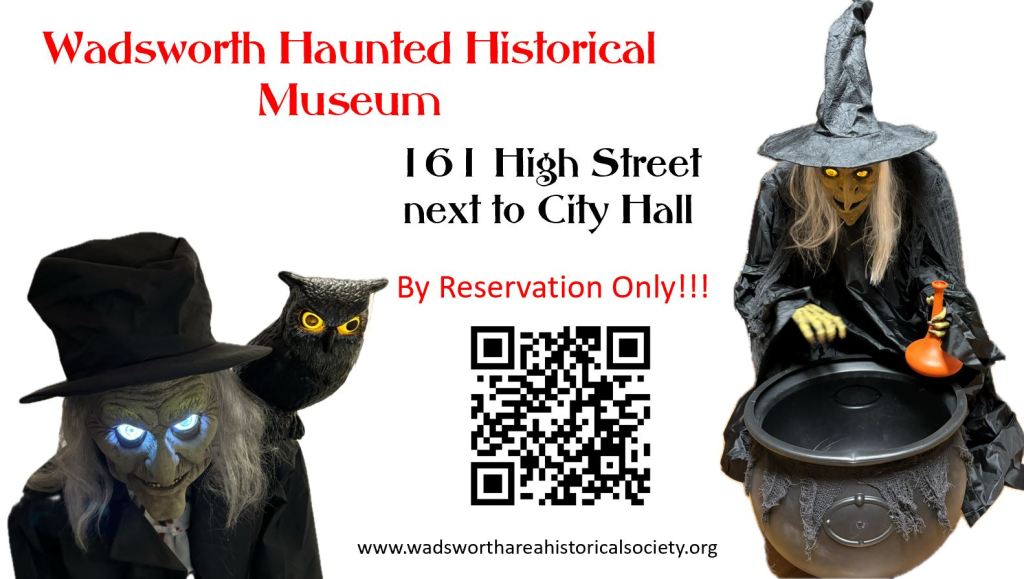
Great news! We are able to extend the reservations for tours of the historical museum located at 161 High Street in downtown Wadsworth. Participants must pre-register on this site. A donation of $10 per person is asked.
Scenes in the museum represent stories of Wadsworth’s haunted past. They are not overly scary; however, children should be 10 or older! Learn about the origin of the Curtis Monument located at the entrance to Woodlawn Cemetery. The story of Sylvia Beach who was lost in the woods and never found. The mysterious murder of Ora Lee will be explained. The Resurrectionists of Woodlawn of Woodlawn Cemetery provided students with the specimens needed to learn about anatomy. Ghosts’ downtown that does not go away are described. Several more Grizzly Tales will come to light!
The tales will be held on three different at various and led by Roger Havens. Cash donations only. If you do sign up, enter at the front gate and wait on the front porch to be let in around your scheduled time. There are times wen the tours may run 5 to 10 minutes late. All tours last approximately one hour.
This event is open to anyone! Please help spread the word.
The museum has been converted into a ‘haunted’ educational attraction for the next two weeks. Many people have inquired about strange occurrences and ‘ghosts’ of Wadsworth. Through visual aids, some of these stories come to light. This is not a typical scary haunted house, but a tour of Wadsworth’s Haunted Past.
It may not be appropriate for children under 10 years old. Groups of no more than 8 people at a time will get a personalized tour of the museum narrated by Roger Havens. A $10 donation to WAHS is asked of each participant. No credit or debit cards may be used. Cash or checks accepted. To sign up, go to this site:
BUILD A TEAM. TABLES SEAT EIGHT. THEIR WILL BE AN OPEN BAR AND THE FOOD IS PROVIDED BY THE WATER MAIN GRILLE. MORE INFO SOON. THIS MUCH FUN SHOULD BE ILLEGAL.
In September of 2019, Caeser Carrino wrote this article for the Wadsworth Area Historical Society newsletter. Since we are a couple of months away from Wadsworth’s largest festival, it may be interesting to review the history of the Ohio Match Company.
Whether you are a Wadsworth native or a recent resident, you have undoubtedly heard of the Ohio
Match Shop, an Ohio Company, and might refer to is as such. From the beginning of the 20th century until past the middle of that century, to natives, it was simply: THE MATCH.
Much history surrounds the Match, such as how it morphed into a single factory for making matches after Wadsworthites made matches in their homes for years before the Match was founded in in the early 1890’s. The reason matches were a popular cottage industry was that those who made matches had no way to insure they would not ignite spontaneously, therein having to carry them by hand to buyers in their neighborhoods. At one time, it was estimated there were dozens of places in Wadsworth that made matches.
With the start of the Industrial Age [mid- to late-1800’s] quick minds began to come up with ideas on how to make matches safer. It was not until sometime after 1910 that this was ‘perfected’. Here lies some intrigue as well as a turning point in what made Wadsworth the Match Capital of the World, as it was known at that time.
The Diamond Match in Barberton was eager to improve its chemical compounds to make matches safer and called upon German chemist, Hugo Shapiro, to assist them.
He had widespread respect as a Chemist in Germany and had devised some ways to mix chemicals in certain ways that made them less likely to ignite spontaneously. Diamond Match brought him from Germany to Barberton to guide them in their chemical processes. Meantime, in Wadsworth, the Match wanted that information as well, so they enticed Hugo from Barberton to come to Wadsworth to do the same. How this was done is not generally know, but several stories abounded that seemed to suggest Wadsworth was clever in its device.
While here, he not only made the matches so they would ignite only when needed, but became aware that some of the chemicals that were being used were dangerous to the health of workers. In fact, he thought some of the deaths of match workers could be attributed to these dangerous chemicals. Hugo corrected that, and, according to those who worked at the Match, wide-spread illnesses began to decrease to a point that it was no more a problem.
Match manufacturing required two huge commodities: chemicals and wood. Chemicals came in barrels and wood in huge logs. Barrels were somewhat manageable with hand-operated ‘trucks’ with two wheels and two handles, but big logs were a bit more problematic. Logs were shipped in by rail. Picking them up was difficult, so, when the logs arrived in Wadsworth, the train would stop at the crossing on Main Street, someone would push the logs off the railroad car and a couple men would roll them down to The Match. Rolling was the order of the day. Many years later, The Match had a rail spur that went right into the Match and continued to the Injector. Logs were rolled off the cars as before, but they would be within a short distance of where they would be cut, first in long timbers, and, by the end of their journey to matchsticks, into billions of sticks measuring about one-eighth inch in diameter by two-and-a-half inches in length.
There was a pecking order within The Match: Those who made the big matches as we know them [called Big Stick] was the highest order; those who made the smaller matches that fit into little boxes [called the ‘wee-wees’] were next; and those who made the matches that were in a folded paper covering [book matches] were at the end. The Match culture was strict: One did not demean an employee who was in the Big Stick department by asking if he worked in the wee-wee department.
There was pride in the hierarchy of match-making. Wadsworth is known for Blue Tip Matches. They also made matches with red tips – Rosebud Matches. Reason: Blue Tips did not sell well in the South, so they made the Rosebud [red] to accommodate the diehard southerners who still had the Civil War on their minds. Remember, The Match started only about thirty years following the end of the Civil War.
The Match was an equal-opportunity employer long before it was a word in our everyday conversations. At one time, The Match employed about 1100 workers, of whom 600 were women. It was not to be politically correct. Rather, it was because women had the dexterity to work in the book match department where the endless strings of ignitable tips were attached to a paper ‘stick’. A machine would cut them into shorter strips, fold them into a paper cover and stitch them to that cover. Those ‘books’ would fit into a paper box of a dimension that would hold twenty-five books of
matches. Women [called stitchers] would be on a long line standing behind the stream of books and would pick up twelve books, put them in the box, then thirteen the next time to fill the box. This was done in a rather fast cadence that would not dare to falter, or the entire line would be in jeopardy.
They did this for several minutes at a time, and then the machine would stop abruptly, giving the women a slight break. After a short pause all of them would go to their respective positions, and instantly the stitchers would resume the lock-step cadence. Men would stand at the end of the line and put the boxes into a large carton for shipping. The carton would then be slid to another area. It was not infrequent that the entire carton would catch fire, sending flames into the high ceiling. It was so common, that no one would turn to look at the flame.
Men usually filled the ranks of workers in big stick and wees. All manufacturing was done on the upper floors, with the ground floor reserved for the Shipping Department, lunch area and the Receiving area. Big sticks were put into manageable cartons and dropped on a two-story ‘slidingboard’. Men would be at the end to pick up the cartons and put them on fairly large wagons that were pushed by ‘mules’, or workers whose skills were limited and seasonal part-timers. The shipping area was immense and was completely filled each day, emptied onto rail cars during the later shifts, therein emptying the floor, only to have it filled the next day.
Wages at the Match were always low. When The Match first began manufacturing, employees made five cents per hour. Fifty years later, wages were in the range of one-dollar per hour. This being said, those who worked at the Match during the Great Depression never earned much money, but they had a steady income. There were few layoffs. The only reason people did not flock to the Match was that there were no job openings. People built their lives around the Match, in that they moved into the neighborhoods close to their work so they had no transportation costs, would go home for lunch and, as their children became of age, would try to get them jobs in the Match.
Of great nostalgia to many Wadsworth residents was the Match Shop whistle that blew at 6:30 a.m., 11:30 a.m. and 3:00 p.m. The Injector whistle blew at 7:00 a.m. 12 noon and 3:30 p.m.
Wadsworth ran by those whistles. To many – most of Wadsworth worked at The Match or The Injector – those whistles also meant that food was on the table because of them.
One-hundred-five years ago, Ohio mandated every child from age six to sixteen would have to go to school for at least 180 days a year. This became what was known as the Compulsory Education Act. Before that date in 1918, parents could choose to send their children to school, and, as a result, many children did not attend regularly and some did not attend at all. It was not unusual for families to keep their children home for farm work, weather conditions or myriad other reasons that were quite ‘legitimate’ at the time.
Massachusetts had the first compulsory education law in 1852 that required children to be educated in a public school setting. [When it was under British rule, the British passed a similar law in 1647.]Parents who refused to abide by the law were fined, and, in some cases, had their children taken from them. The cogent word here is ‘public’, because, at the time, most education was meted out in church related schools, principally Catholic, but Lutheran and other Protestant and Jewish denominations as well. The 1852 Massachusetts law had two platforms for passing the law: Fear that the religious schools would try to proselyte children, and fear that if children were idle, they would fall prey to being forced to work as adults.
Wadsworth was ahead of the game. One of the first efforts of the first families that arrived from Connecticut was to establish a school. The first settlers arrived in 1814, and almost before they had cleared all the trees or made any semblance of a road to get from one place to another, they built a school in 1818. The first school was at the end of what is now Hartman Road and Broad Street, almost directly east of the traffic light. It was so small, that the next year they built a school at what is now the other end of Hartman Road that meets Route 261. There was no road there, and the students – as well as the teacher – had to wend their way to the school through dense forests. Although the first settlers set up their first camp in what is now Western Star, there were families farther north, principally the Beach family whose original barn serves as the foundation of the Haynes barn on Route 261.
The ‘come when you feel like it’ that prevailed in other places did not take hold in Wadsworth. The first settlers came from English-dominated Connecticut, where the old English tradition of education was well established. As a result, even though there was no compulsory education law, students were all but forced to attend school. It might be said that going to school was the ‘cool’ thing to do, so parents and students alike made school attendance a priority.
Education was a priority for many. One that stands out is Burke Hinsdale, who became President of what is now Hiram College, was a nationally known educator. He went to school only when farm work on what is now Reimer Road waned. He confessed in his memoirs that he yearned to go to school and found ways to do so despite overburdening chores. A brilliant student, his knowledge far exceeded what he could have learned from the teacher who taught at the one-room school just north of Wadsworth and into what is now Sharon Township, so he begged his parents to let him go to the Western Reserve Eclectic Institute in Hiram, Ohio. The WREI became Hiram College, and its President was James Garfield, who later became the President of the United States. Garfield’s student aid was Burke Hinsdale, whose prowess as a stellar scholar shone even at a young age, so much so, that the trustees of Hiram named him President.
However, not all were enamored with the new law: When the law was passed in 1918, many parents rebelled, basing their opposition to the law on taking away the right of parents to educate their children. Many accounts of ‘forcing’ children to attend school at least until age sixteen, but permitted until age nineteen, was contested by many groups, especially the agricultural people who depended upon their children to work the farms. Also, in 1918, the Spanish Flu became a pandemic and parents were afraid to send their children to school. Although we have the same problem with the Covid19 pandemic, there were no other options for purveying knowledge to students as we have today through virtual means.
The Spanish flu lasted at least for a couple years, and many people died. Parents railed against the school administrators who were forced to uphold the law. Parents also found every means imaginable to keep their children from attending school. There are accounts of people not revealing birth of children, citing religious reasons for keeping them home, feigning ill health, etc. School administrators – usually Principals or Superintendents – would go to individual houses to ferret out the students. Some parents complied, but others did not. The Wadsworth Town Marshall was charged with the responsibility to ‘convince’ the errant students to return to school. At the time, there were only about 4000 people living in Wadsworth, with only about 800 students between the ages of six to nineteen. One account indicated that, at the height of the pandemic, many classrooms had only five or six students in attendance.
In addition to students refusing to attend classes, there were many teachers who refused as well. They were told to keep their students away from them and to apply a soap made with lye to wash their hands, forearms and faces several times throughout the day, and to rinse their mouths with salt water frequently. In the high school, P. V. Kreider, was Principal and an English teacher. There were only six teachers, a minimal number that was appropriate for the inconsistent attendance that existed before 1918 but a number that bloomed after the pandemic. Only twenty-five students elected to graduate. Approximately one-third of the class that started in first-grade in 1908 dropped out by age sixteen.
Seniors who were prominent in Wadsworth many years ago and who graduated at the height of the Spanish Flu pandemic in 1920 were: Clara Beck Brenneman, a pharmacist; Elva Hartman Brintlinger Baldwin, a teacher in Wadsworth schools; and, Mike Motzko, a barber. Although senior activities were not as profuse as they are today, what few they had were curtailed during the pandemic.
One of the conundrums that plagued Ohioans was that the Legislature enacted a tax on every home owner in Ohio for education in 1825, despite the fact that there were few who attended schools regularly. At the time there was an outcry from the general public about the tax, insisting that it was totally unfair since only so few took advantage of it but every homeowner had to pay. Property taxes supported other elements of local government, but today approximately 65 percent of all property tax dollars go to education. The controversy still remains, with groups protesting having to pay property taxes for education when there are so many disparities in the quality of education throughout the State.
The practice of the school administrator going to every home in Wadsworth for ‘census’ purposes lasted from 1918 until about 1936 in the Township School District. The Wadsworth City School District continued the practice for only a few years beyond the enactment of the law, principally because fewer city students would not have the need to work on farms.
Human Nature is always and everywhere the same. People resisting being told what to do; people resenting paying for someone else’s advantage; people fearing personal contamination through disease; people agonizing over expected pleasure only to have it extinguished by a pandemic; and people believing the government should not legislate any law that restricts freedom. All the above occurred over one-hundred years ago. It could have been written today. All we would have to do is change the dates.
During the past month the WAHS has been meeting to create a new strategy on how we may bring our history alive to our local residents. Many ideas are on the table at present, including more historical markings, interactive, having reenactors to bring the past face to face and bringing in representatives from area historical societies for cultural exchanges.
All in all we have nearly eighteen ideas we are looking at. As always we want to keep the children and young adults interested in our heritage. When we decide on how to best present our ideas we will be seeking our residents for volunteer work. Stay tuned as we progress on these ideas.
We also will be adding a railroad switch for our Erie Lackawanna tracks. It is vey heavy so finding the right location to display it is under consideration. The new pergola is still waiting for completion and Roger Havens is keeping us informed on the progress. Also the donated locks are still being repaired but we should have them displayed soon in the museum.
March First Friday was a very busy night at the Johnson House Museum. Art work from local students were displayed around town. We hosted the unique talents of the Franklin students. Of course the odor of doughnuts wafted all about town bringing in numerous hungry visitors.
Tonight, March 9th, Mike Burg, author of The Wadsworth Area Homicides will be giving his talk at 7:30 at the Wadsworth Library conference room.
April’s First Friday will be the British Invasion. Keep an eye on our Facebook page for more detail.



 Wadsworth Area Historical Society